Reading Eggs and Writing Legends have both earned Pedagogical Quality Certification from EdTech Impact – an independent evaluation backed by University of Helsinki research.
The assessments found excellent ratings for active learning design (93/100 for Reading Eggs, 92/100 for Writing Legends), strong curriculum alignment with The National Curriculum for England*, and high learner engagement across both programs.
*Our reading program is also compatible with a range of international curricula, making it suitable for worldwide use.
What is EdTech Impact?
EdTech Impact provides independent, research-based evaluation of digital learning tools. Their Quality Framework is used by over 400,000 educators and school leaders across 130+ countries to inform procurement decisions.
The framework assesses products across four key pillars: lawful and ethical practices, quality and pedagogy, user experience, and research impact.
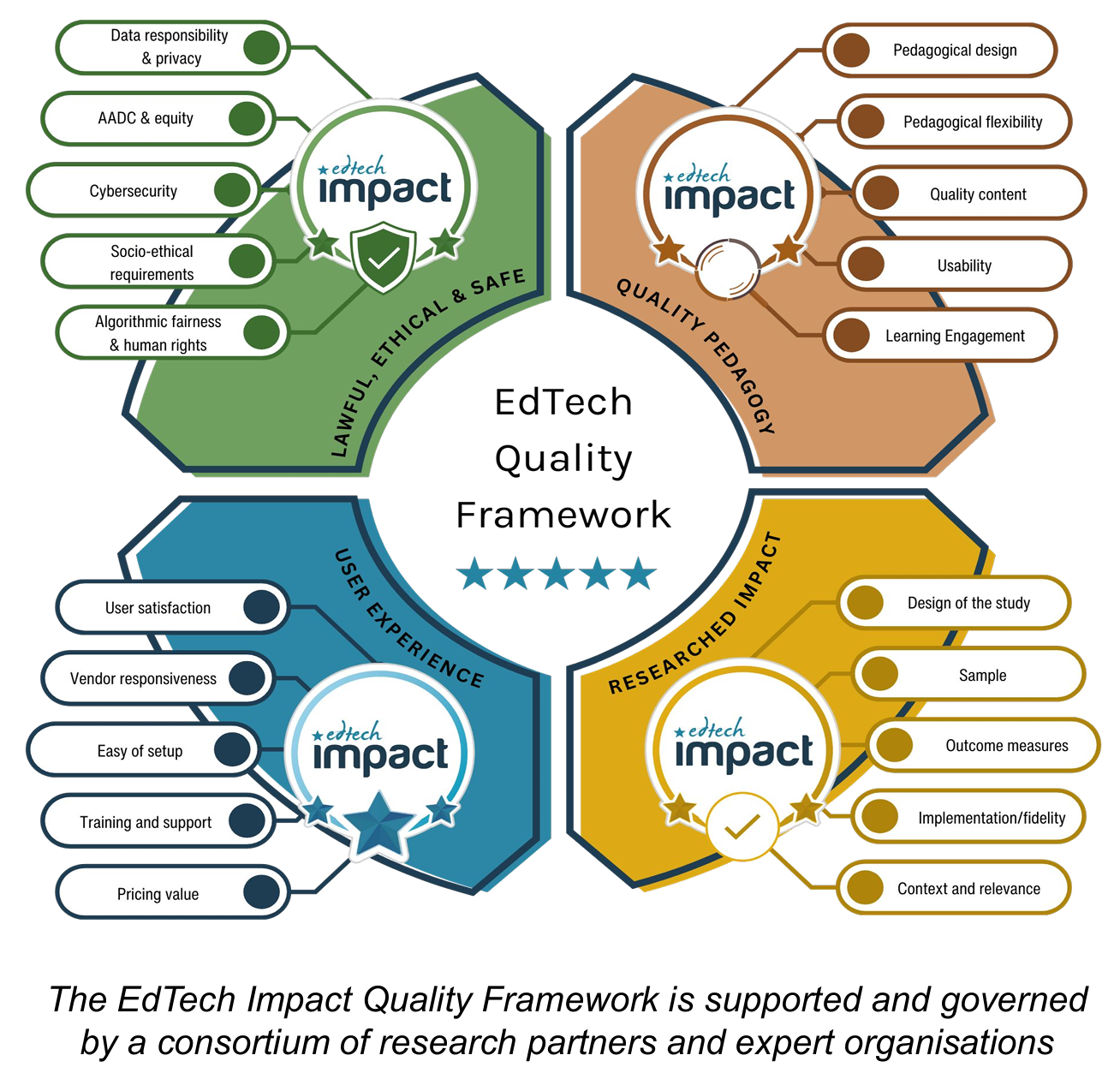
The Pedagogical Quality Certification focuses specifically on learning goals, pedagogical approach, and learner engagement – evaluating how well a product supports effective teaching and learning.
About Reading Eggs and Writing Legends
Reading Eggs delivers comprehensive literacy instruction aligned with the Science of Reading, covering phonics, phonemic awareness, vocabulary, fluency and comprehension for R–7 students, while Writing Legends provides structured writing instruction across text types for Years 1–6.
Together, they create a complete literacy progression from early reading foundations through to independent writing and composition skills.
Independent evaluators confirmed that both programs:
- Align strongly with UK reading and writing curricula expectations.
- Provide structured, progressive learning pathways.
- Support active, scaffolded learning with immediate feedback.
- Create inclusive, motivating learning environments with high engagement scores.
Below is a breakdown of the evaluation findings for each program.

Learning Goals: Strong alignment to UK reading and writing curricula
Reading Eggs:
Evaluators confirmed that Reading Eggs aligns closely with foundational reading expectations across phonics, word recognition, vocabulary development, comprehension and early fluency.
The review found Reading Eggs:
- Provides clear, sequenced instruction aligned to early reading curricula.
- Supports essential early literacy goals, including phonemic awareness, decoding and early comprehension.
- Includes structured pathways that progressively build reading confidence and accuracy.
This alignment ensures Reading Eggs reflects the instructional intent of early years literacy frameworks.
Writing Legends:
Evaluators mapped Writing Legends against the English Writing curriculum (Key Stages 1 and 2), confirming coverage of key composition skills.
The review found Writing Legends supports:
- Sentence construction.
- Planning, drafting and revising.
- Narrative, non-narrative and purpose-based writing.
- Evaluating and improving writing.
- Grammar, vocabulary and spelling conventions.
The program includes a broad range of didactic and facilitative learning goals, ensuring both direct instruction and opportunities for application.
Together, Reading Eggs and Writing Legends provide a coherent progression from foundational reading to confident, independent writing.

Pedagogical Approach: High performance across all four dimensions
EdTech Impact evaluates pedagogy using four research-based contrary pairs. Reading Eggs and Writing Legends both scored Good to Excellent across all dimensions.
Reading Eggs:
Passive → Active – Excellent
- Children learn by doing, through interactive phonics, vocabulary and comprehension tasks.
- Immediate feedback helps consolidate early reading skills.
- Activities progress gradually in difficulty, supporting mastery and confidence.
Rehearse → Construct – Good
- Opportunities to practise decoding, blending and comprehension.
- Gradual introduction of new concepts, embedded in meaningful reading tasks.
- Learners can revisit lessons for consolidation.
Linear → Non-linear – Excellent
- Learners follow a clear, sequenced pathway.
- Teachers can adjust placement and progression.
- Additional learning areas (e.g., spelling, storylands) provide non-linear exploration.
Individual → Collaborative – Supported
- Independent progression is strongly supported.
- Activities are designed for self-paced learning.
Reading Eggs provides motivating interactive activities that encourage learners to apply emerging reading skills independently.
Writing Legends:
Passive → Active – Excellent
- Learners have autonomy to select writing ideas, review previous work, or revise spelling and vocabulary.
- Scaffolded writing lessons build confidence and motivation.
- Ladder-like progression supports gradual skill development.
Rehearse → Construct – Excellent
- Adaptive support based on learner errors.
- Opportunities to apply writing strategies in open-ended tasks.
- Revision and improvement embedded in the writing process.
Linear → Non-linear – Outstanding
- Combines structured skill-building with creative, open-ended writing prompts.
- Learners can move flexibly between lessons, practice areas and revision tasks.
Individual → Collaborative –Excellent
- Learners can set personal writing goals.
- Optional collaboration supports varied learning preferences.
Writing Legends supports the learner well with scaffolding, tools and encouragement to proceed confidently. Learners are empowered to engage with content as they see fit – moving forward, practising skills or revisiting areas needing development.

Learning Engagement: Strong support for motivation, confidence and safety
Both programs performed well across the six dimensions of learning engagement.
Reading Eggs:
Autonomy – Well Supported
- Clear learning goals.
- Balanced mix of instruction and practice.
Competence – Well Supported
- Meaningful rewards reinforce progress.
- Activities adapt to learner needs.
Relatedness – Supported
- Characters and stories help build connection.
Respect – Well Supported
- Inclusive, age-appropriate design.
- Support for inexperienced learners.
Stimulation – Well Supported
- Engaging graphics, sounds and pacing.
Safety – Supported
- No harmful content.
- No irreversible errors.
Writing Legends:
Autonomy – Well Supported
- Learners can choose activities and writing tasks.
- Clear goals and strong motivation built into design.
Competence – Well Supported
- Automated scoring breaks down strengths and next steps.
- Praise, rewards and feedback promote persistence.
Relatedness – Supported
- Strong use of examples and modelling.
- Motivating fictional contexts.
Respect – Well Supported
- Inclusive narratives.
- Suitable for learners of different experience levels.
Stimulation – Well Supported
- High-quality visuals.
- Optimal challenge level.
Safety – Well Supported
- No harmful or discouraging content.
- Mistakes are reframed as learning opportunities.

What this means for schools and MAT leaders
These independent evaluations confirm that:
Reading Eggs:
- Strongly aligns to early reading curriculum expectations.
- Provides structured, developmentally appropriate instruction.
- Supports phonics, vocabulary, fluency and comprehension.
- Promotes learner motivation and confidence.
Writing Legends:
- Closely aligns to UK writing composition requirements.
- Supports both structured skill development and creative writing.
- Provides meaningful feedback and opportunities for improvement.
- Encourages autonomy and engagement.
Together, they offer a research-backed literacy progression from early reading through to confident writing – making them valuable components of a whole-school or multi-academy trust literacy strategy.
Looking for an integrated whole-school literacy and numeracy solution?
Reading Eggs and Writing Legends are part of 3 Essentials – our integrated package combining Reading Eggs, Writing Legends, Mathseeds, and Mathletics for comprehensive learning support.
Reading Eggs, Writing Legends and Mathletics have each earned independent Pedagogical Quality Certification from EdTech Impact.