If you’ve ever read aloud to a child, you may recognize this moment. It’s bedtime. You’re curled up with a book – Charlotte’s Web, perhaps – and the child listening beside you isn’t reading the words yet. They don’t recognize every letter. They may not even know all their sounds.
This doesn’t stop them from being deeply engaged.
They’re wondering why Fern wanted to save Wilbur. They’re laughing at Templeton’s sarcasm. They’re marveling at Charlotte’s clever web messages and asking what words like humble or radiant really mean.
In moments like these, children are building something essential: language comprehension.
Long before fluent decoding, they are developing vocabulary, syntax, and background knowledge – the very skills that make reading comprehension possible later on.
As educators, we work tirelessly to ensure students learn to decode. But if we’re not equally intentional about developing language comprehension, we risk leaving one of reading’s most critical strands underdeveloped.
Why language comprehension matters
Many states and districts have embraced the Science of Reading to guide literacy instruction – and rightly so. The Science of Reading is not a curriculum or a program. As defined by The Reading League, it is a large body of interdisciplinary research explaining how students actually learn to read and write.
One of the clearest findings from this research is that reading does not develop naturally the way spoken language does. While children typically learn to speak through immersion and interaction,
reading and writing require explicit, systematic instruction and sustained practice over time.
Undoubtedly, decoding – mapping sounds (phonemes) to letters (graphemes) – is a foundational skill. Without it, students cannot access text. But decoding alone does not guarantee understanding. To ensure real understanding, they also need language comprehension.

The Reading Rope and the simple view of reading
Scarborough’s Reading Rope helps us visualize reading development as two interwoven strands:
- Word recognition (phonological awareness, decoding, sight recognition)
- Language comprehension (vocabulary, syntax, background knowledge, verbal reasoning)
According to the Simple View of Reading:
Reading comprehension = decoding × language comprehension.
Both components must be strong. If either is weak, comprehension suffers.
This explains why some students can read fluently but struggle to explain what they’ve read, and why others understand stories read aloud beautifully but struggle when asked to read independently.
Thus, we must see language comprehension for what it is: an anchor strand.
Is there an “order of operations”?
Teachers often ask: Should we focus on decoding first and worry about comprehension later?
The answer, as we know from research, suggests this is a false choice.
Language comprehension begins before formal schooling. From birth, children are immersed in spoken language, conversation, and environmental print. Long before they can decode, they are building knowledge of how language works.
At the same time, decoding must be taught explicitly and systematically. These processes develop side by side.
Think of the Reading Rope being woven strand by strand. Some strands strengthen earlier, others later, but they all matter.
When language becomes the limiting factor
In early reading, students often encounter very simple texts:
Pat sat. Sam sat.
These texts serve an important purpose: they allow students to practice decoding with confidence. They’re easy to read, but they don’t reflect the richness of the language students use and hear every day.
On the playground, students negotiate rules, tell stories, and use far more complex language than what early decodable texts require.
As students get older, however, gradually the texts become more complex. Sentences grow longer. Vocabulary becomes more academic. Background knowledge matters more.
At this point, language comprehension can become the bottleneck.
Research shows that by eighth grade, much of the difference in reading achievement is explained not by decoding skill but by language comprehension.
Consider the difference:
- The snow falls.
- As the afternoon sun faded behind the snow-capped mountains, snowflakes with intricate patterns drifted down to blanket the valley below.
Same event, very different language demands – but only one requires deep vocabulary knowledge, syntax awareness, and conceptual understanding.
What this means for classroom instruction
The good news is that language comprehension is highly teachable – when we are intentional.
Below you’ll find three powerful, research-supported practices that teachers and literacy coaches can use to strengthen language comprehension every day.
1. Interactive read-alouds: language beyond the page
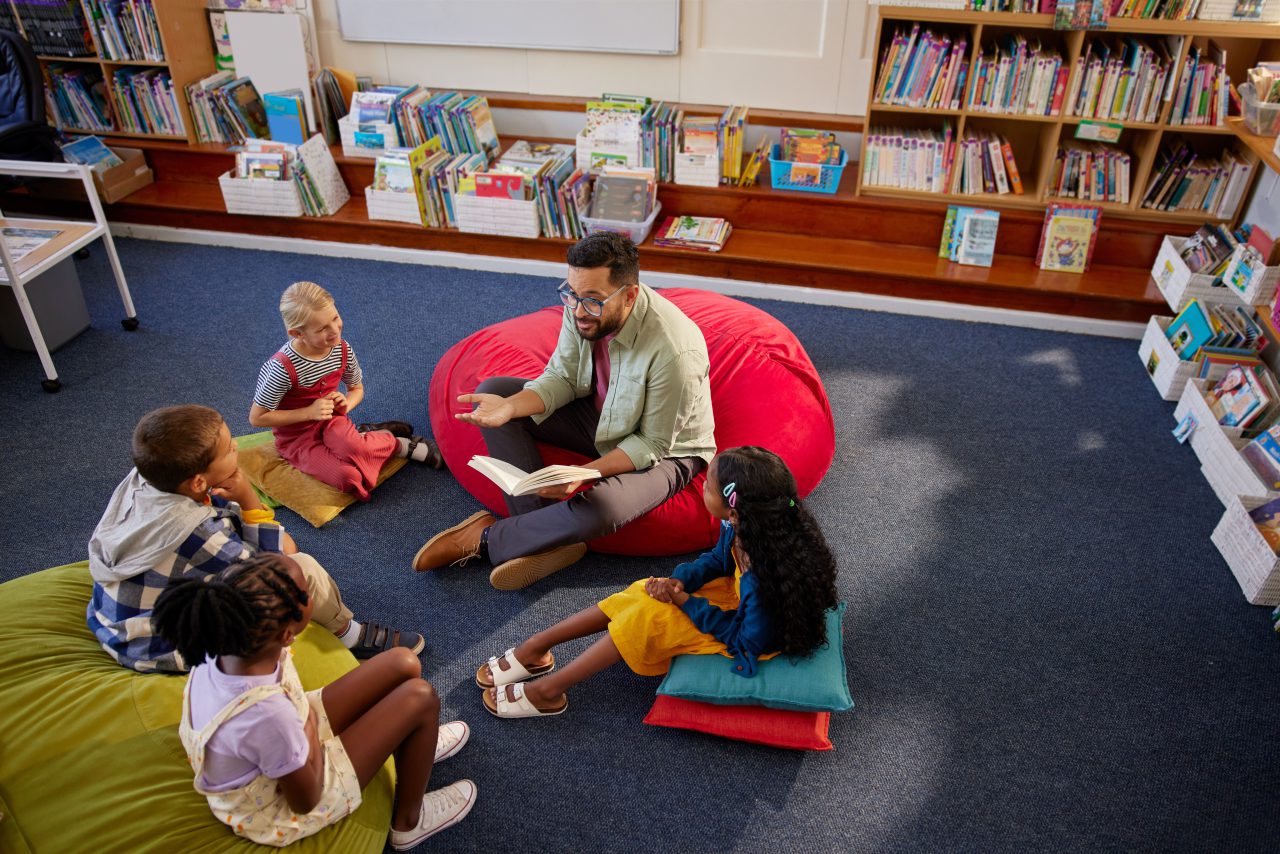
Read-alouds are one of the most effective tools we have for building language comprehension across grade levels.
When teachers read rich, complex texts aloud:
- Students hear advanced vocabulary and sentence structures
- They are exposed to ideas beyond their independent reading level
- They build background knowledge across subjects
Importantly, read-alouds should include both narrative and informational texts. Stories support literary language and character development. Informational texts build academic vocabulary and content knowledge in science, math, and social studies.
How can educators make read-alouds instructional?
Effective read-alouds are interactive, not passive. Consider these guidelines:
- Choose texts rich in language and ideas
- Preview and intentionally teach high-utility vocabulary
- Offer brief, clear explanations for unfamiliar words
- Pause for discussion and student talk
- Ask questions that promote thinking, not just recall
- Include opportunities for students to reflect orally or in writing
Well-designed read-alouds “upload” language patterns into students’ minds. Patterns they later draw on as readers and writers.

2. Dialogic reading and meaningful conversation
Language comprehension grows through talk. Dialogic reading shifts the focus from teacher talk to student talk, encouraging children to actively engage with texts through conversation.
One effective framework is the PEER technique:
- Prompt students with a question
- Evaluate their response
- Expand by adding new language or ideas
- Repeat to reinforce understanding
For example:
- “Where do the villagers live?”
- “That’s right! How did you know?”
- “They live in a valley at the base of the mountains.”
- “Tell me again where they live.”
These conversations:
- Deepen comprehension
- Build vocabulary naturally
- Support oral language development
- Increase student confidence
For hesitant speakers, dialogic reading provides a safe, structured way to participate while explicitly teaching conversation skills.

3. Explicit vocabulary instruction: teaching words on purpose
While children do learn words incidentally, research shows that explicit vocabulary instruction is essential (especially for academic language).
Effective vocabulary instruction includes:
- Teaching word meanings in context
- Revisiting words multiple times
- Encouraging use in speaking and writing
- Teaching morphology (prefixes, roots, suffixes)
For example, teaching the prefix un- helps students unlock meaning in words like unkind, unfair, unusual, and unreachable.
Words of the Week
Teachers can try this idea for a simple and effective classroom routine:
- Select 3–5 content-rich words each week
- Introduce them in context
- Break down word parts
- Practice spelling and usage
- Use them intentionally across subjects
- Play word games
- Celebrate students when they use new vocabulary naturally
The good news about vocabulary is that it’s cumulative, i.e. each word learned makes the next word easier to understand.

The role of literacy coaches
For literacy coaches, this work is about supporting coherence:
- Helping teachers see language comprehension as part of Tier 1, not an add-on
- Modeling instructional practices during coaching cycles
- Supporting lesson planning that integrates vocabulary and discussion
- Reinforcing consistent language across classrooms
Coaching conversations can focus on questions like:
- Where are students getting access to rich language?
- How often are they talking about texts?
- Which words are being taught explicitly – and revisited?
Final thoughts
Language comprehension does not develop overnight. Unlike Charlotte’s web, it isn’t spun in a single moment. It grows gradually, strand by strand, through consistent, intentional instruction.
As educators, we work hard to teach phonics and decoding.
But if we want students to truly read to learn, we must be just as deliberate about building vocabulary, syntax, and knowledge every day.
The time when language comprehension was viewed as the finishing touch of reading instruction is over. Now, educators should see it as the foundation that holds everything together.
When we strengthen it, we give students the tools to understand complex texts, express their thinking, and succeed far beyond the early grades.